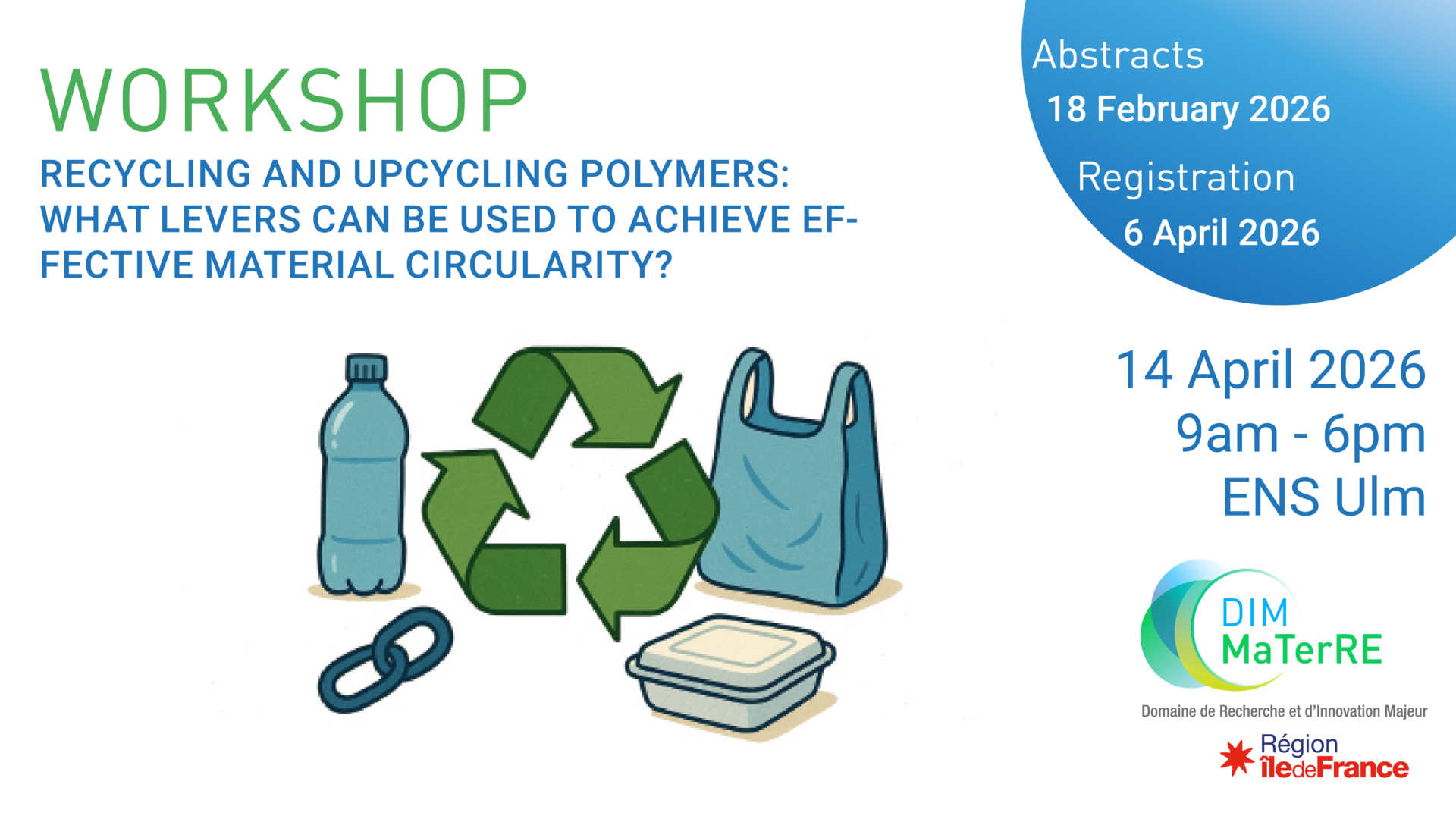
Workshop « Recyclage et upcycling des polymères »
Informations sur l'évènement
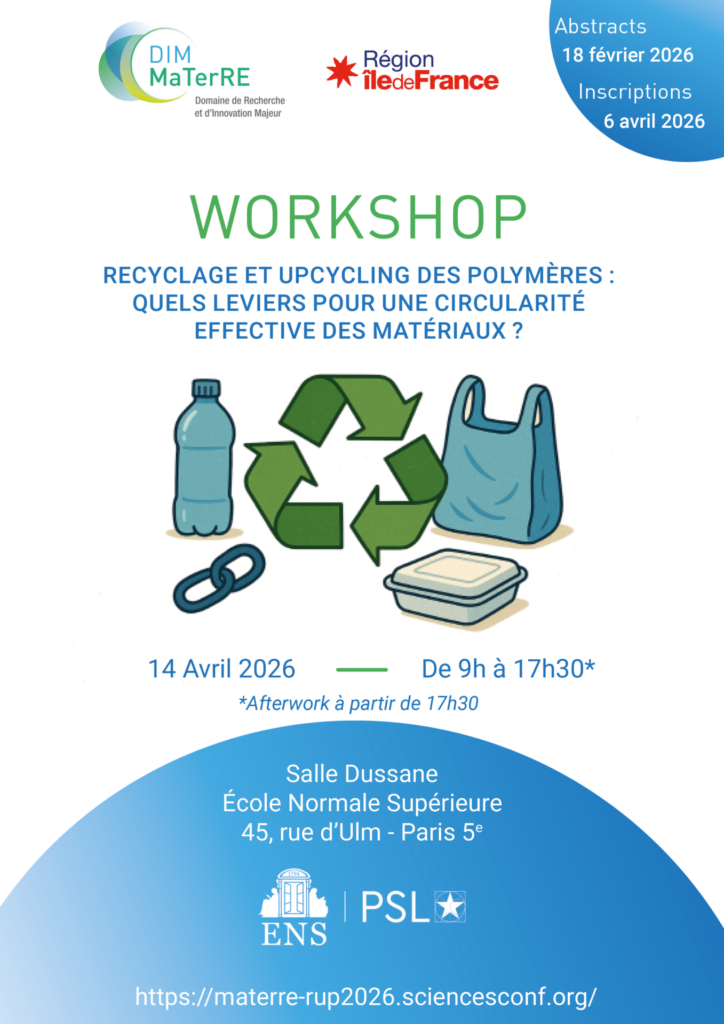
Les inscriptions sont closes. Ce workshop organisé par le DIM MaTerRE se tiendra le 14 avril 2026 à l’ENS Ulm.
Le workshop « Recyclage et upcycling des polymères : Quels leviers pour une circularité effective des matériaux ? » a pour objectif de rassembler chercheurs, ingénieurs, et acteurs industriels afin d’échanger autour des stratégies innovantes de recyclage et d’upcycling des polymères, dans un contexte où la transition vers une économie circulaire des matériaux devient une priorité scientifique et sociétale.
Malgré les progrès récents en matière de tri, de collecte et de régénération des plastiques, les procédés actuels peinent encore à atteindre des performances environnementales et économiques suffisantes pour assurer une circularité réelle. Les approches de recyclage chimique, enzymatique ou mécanique présentent chacune des avantages et des limites en termes d’efficacité, de sélectivité et d’empreinte carbone. Parallèlement, l’upcycling, qui vise à transformer les déchets plastiques en matériaux à plus forte valeur ajoutée, ouvre de nouvelles perspectives, mais pose également des défis en matière de faisabilité technique, de compatibilité chimique et de durabilité des produits obtenus.
En favorisant un dialogue pluridisciplinaire entre chimistes, spécialistes des procédés, experts en ACV et en analyse des flux de matière, ce workshop vise à identifier les verrous actuels et les leviers technologiques, économiques et réglementaires permettant de renforcer la circularité des polymères.
Nous souhaitons ainsi explorer collectivement les pistes de conception, de modification et de réutilisation des matériaux polymères qui permettront d’intégrer pleinement les notions de recyclabilité et de valorisation dans les stratégies de développement durable des matériaux du futur.
Conférences invitées :
Sylvain CAILLOL – From Natural Phenols to Circular Polymers: A Platform Strategy for Sustainable Functional Materials
Cashew nutshell liquid (CNSL) is a unique, non-edible, phenolic lipid derived from agricultural waste, offering an exceptional combination of aromaticity, functionality, and intrinsic reactivity. CNSL represents a highly versatile molecular platform for the sustainable design of next-generation polymeric materials. Beyond CNSL, other naturally occurring phenolic compounds—such as lignin-derived phenols —represent a rich and largely untapped source of bio-based building blocks for polymers.In our work, we have developed a platform-based functionalization strategy to transform CNSL and other natural phenols into monomers suitable for the synthesis of a wide range of polymers, including polyurethanes, phenolics, epoxy resins, alkyds, and poly(meth)acrylates.This approach enables the rational design of materials with tunable thermal, mechanical, and interfacial properties, while maintaining a high bio-based carbon content. Beyond polymer synthesis, these intermediates offer compelling opportunities to substitute toxic or petroleum-based components traditionally used in polymer formulations, such as bisphenols, aromatic amines, and plasticizers. Particular emphasis was placed on the use of CNSL derivatives as safer, renewable alternatives aligned with regulatory and health constraints. Finally, we recently highlighted emerging applications of CNSL-based compounds as recycling and reprocessing agents for end-of-life polymeric materials, contributing to material circularity. By combining bio-based synthesis, functional performance, and end-of-life considerations, this work illustrates how CNSL can serve as a cornerstone of a circular and sustainable polymer design framework.
Biographie : Sylvain Caillol est directeur de recherche au CNRS. Ancien directeur de département chez Rhodia, il a dirigé le département de recherche sur les polymères au centre de recherche d’Aubervilliers. En 2007, il a rejoint le CNRS à l’Institut Charles Gerhardt de l’université de Montpellier, où il a lancé un nouveau programme de recherche consacré à la chimie verte et aux polymères biosourcés. Il est coauteur de plus de 200 articles, brevets et chapitres d’ouvrages. Il a remporté le prix Green Materials en 2018 et 2020 et a été nommé chercheur pionnier par la Royal Society of Chemistry en 2019. Il est rédacteur en chef de Green Materials (ICE).
Coralie Jehanno – How can we transfer recycling technologies from lab to market?
Polykey Polymers S.L. is a Spanish start-up which have arisen from the POLYMAT Basque Excellency Research Centre in San Sebastian in 2020 with the objective of contributing to the future of the polymer industry with a strategic vision and commitment to innovation and sustainability. The company emerged as a polymer producer and R&D service provider acting in three areas
established as objectives for a transition to a sustainable future: (1) the synthesis of bio-based polymers, (2) the selective chemical recycling of commodity plastics and (3) the synthesis of innovative materials for next generation batteries, organic solar devices, or advanced bioelectronics. To address the current challenges of the polymer chemistry industry, POLYKEY
offers its collaborators and clients a portfolio of cutting-edge technologies and a diverse catalogue of high-performance products tailored to each of these three important areas. After an introduction about the company and a summary of the recent accomplishments and future challenges, the presentation will focus on the scaling up and entrance into the market of the different technologies developed at POLYKEY and notably the chemical recycling of polyester at low temperature.
How can we successfully transfer a chemical reaction from the beakers of an academic laboratory to the realities of industrial production? How do you build a company capable of delivering a positive impact on both the environment and society? And how can a small startup scale its operations to a level that earns credibility in a market dominated by established giants? After almost 6 years of experience in technology transfer, process development and sustainable innovation, this presentation aims to share what we have learned as a small, ambitious player striving to reshape the polymer industry from within.
Biographie : Coralie a obtenu son doctorat en chimie des polymères en 2019 à l’Université du Pays basque (UPV/EHU) en cotutelle avec l’Université de Warwick (Royaume-Uni). Ses travaux de doctorat ont porté sur le recyclage des déchets plastiques, pour lesquels elle a reçu le prix Accesit de la meilleure thèse en chimie des polymères décerné par la Société royale espagnole de chimie (RSEQ). Après son doctorat, elle a combiné une carrière universitaire en tant que post-doctorante dans le groupe de recherche du professeur Haritz Sardón avec l’aventure entrepreneuriale en fondant la start-up POLYKEY, axée sur la promotion des plastiques durables. En tant que directrice scientifique de POLYKEY, son travail quotidien comprend l’établissement d’une stratégie commerciale, la gestion de projets, le transfert de technologie et la supervision de 6 employés. En près de 6 ans, l’entreprise a attiré plus de 200 clients et collaborateurs, plus de 4 millions d’euros de financements et remporté 5 prix.
Sa solide expertise dans le domaine du recyclage des plastiques et des polymères durables lui a valu deux brevets et plus de 25 articles dans des revues prestigieuses, qui ont été cités plus de 3 000 fois. En 2024, elle a reçu le prix du meilleur post-doctorant décerné par la Société royale espagnole de chimie (RSEQ). Elle a co-dirigé trois thèses de doctorat couronnées de succès et co-dirige actuellement trois doctorants. Coralie s’est personnellement impliquée dans diverses activités de vulgarisation scientifique, notamment les semaines locales de la science, la participation à l’événement « Pint of Science » ou la participation à des événements promouvant les carrières des femmes dans le domaine scientifique.
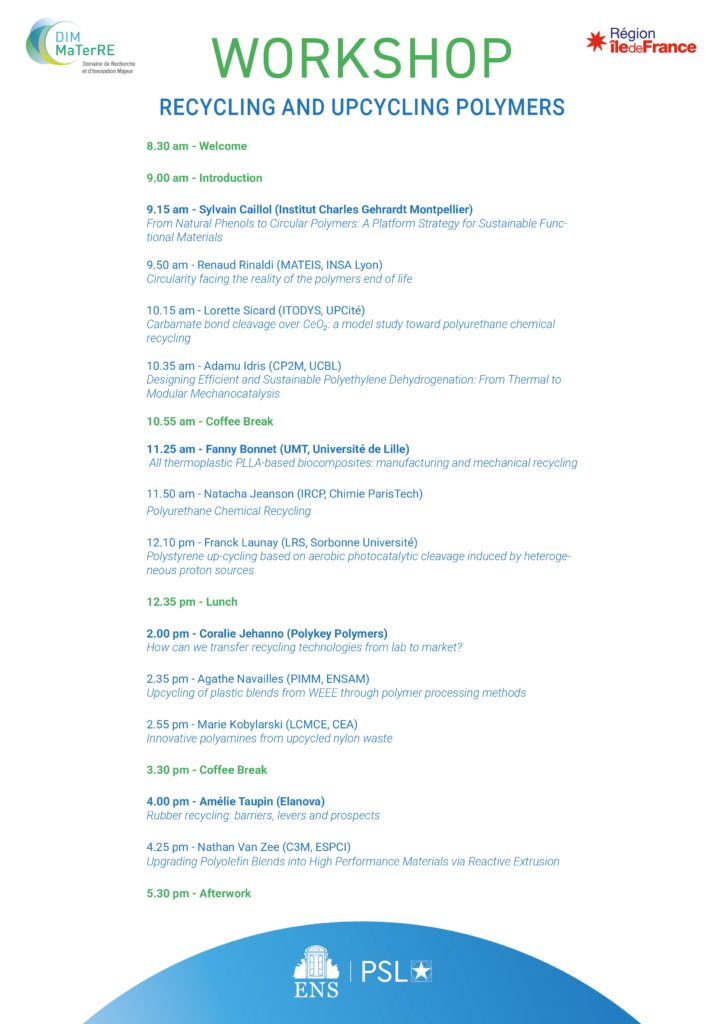
Programme
Appel à contributions et inscriptions :
L’appel à contributions est désormais clos.
L’inscription est gratuite mais obligatoire jusqu’au 6 avril 2026.