
invisible-NMR
Making the invisible visible: Multinuclear NMR for sustainable aqueous batteries
A custom low-gamma NMR probe to decode molecular structure and transport
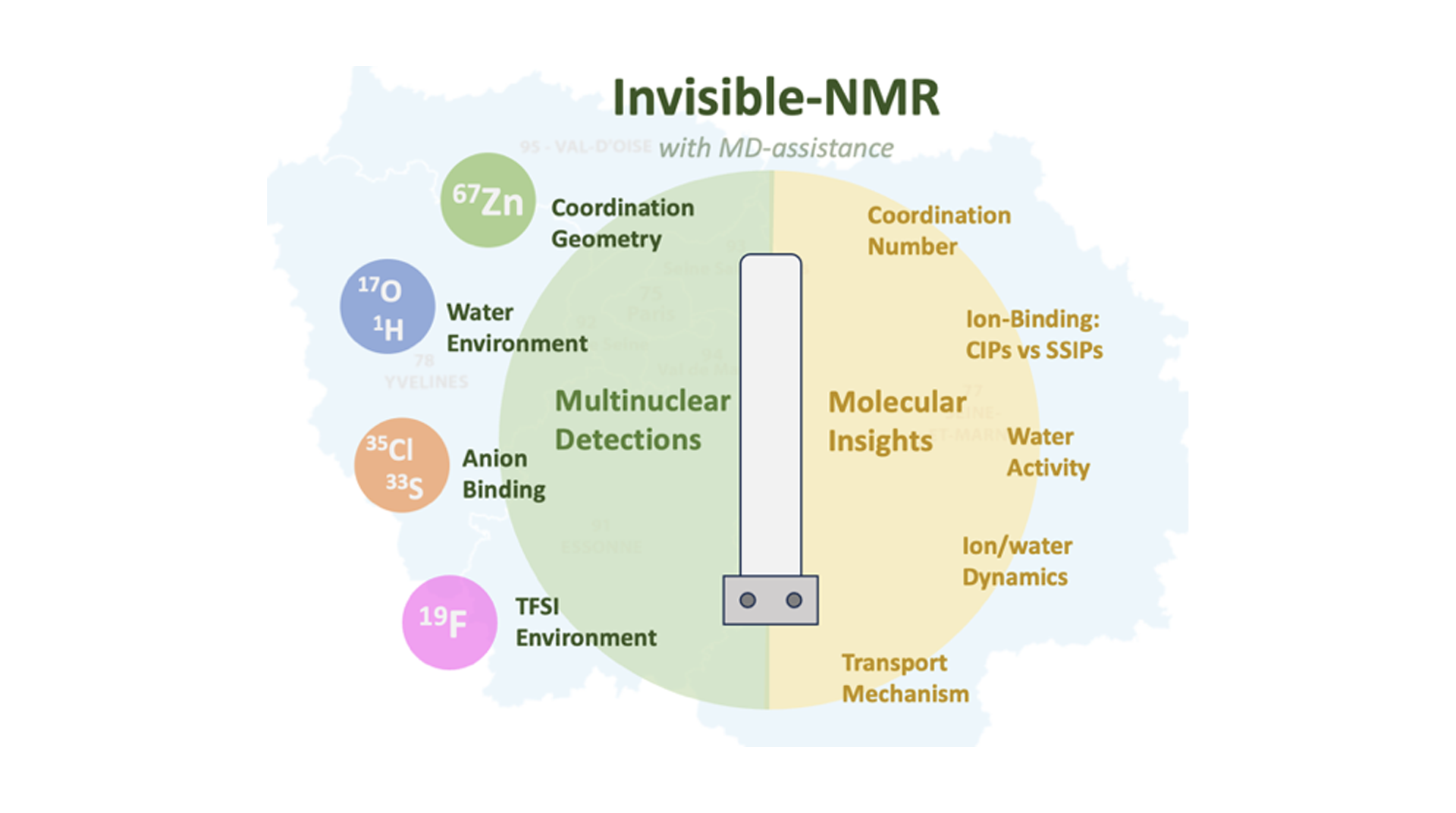
Sustainable aqueous battery technologies (Li⁺, Na⁺, Zn²⁺, Mg²⁺, Ca²⁺) offer transformative advantages with 50-70% lower CO₂ emissions and inherent safety compared to conventional systems. While nearly all NMR characterization studies focus on favorable high-gamma nuclei (⁷Li, ²³Na), the critical lowgamma quadrupolar nuclei—¹⁷O (water/anion coordination), ⁶⁷Zn (zinc solvation), ²⁵Mg and ⁴³Ca (multivalent cations), ³⁵Cl and ³³S (anion interactions)—remain untouched and invisible to most standard NMR equipment. This blind spot prevents direct observation of the molecular-level solvation structures and ion transport mechanisms essential for rational electrolyte design.
This MaTerRE project, invisible-NMR, will acquire a custom NMR probe specifically targeting the invisible nuclei across all sustainable aqueous battery chemistries. We will first validate the methodology on Aqueous Zinc-Ion Batteries (AZIBs)—the most challenging system due to ⁶⁷Zn’s low NMR receptivity—demonstrating proof-of-concept for systematic expansion to sodium, lithium, and multivalent systems. This project will reveal how zinc ions interact with water and other molecules at the atomic level, providing molecular blueprints for superior electrolyte design. By making the invisible visible, we establish the scientific foundation for next-generation sustainable energy storage.