

HYPER-MAT
Thermoelectric waste heat recovery represents a promising approach to powering low-power autonomous electronic devices, particularly in the fields of flexible electronics and the Internet of Things (IoT). However, currently available organic thermoelectric materials still exhibit insufficient performance to enable large-scale deployment.
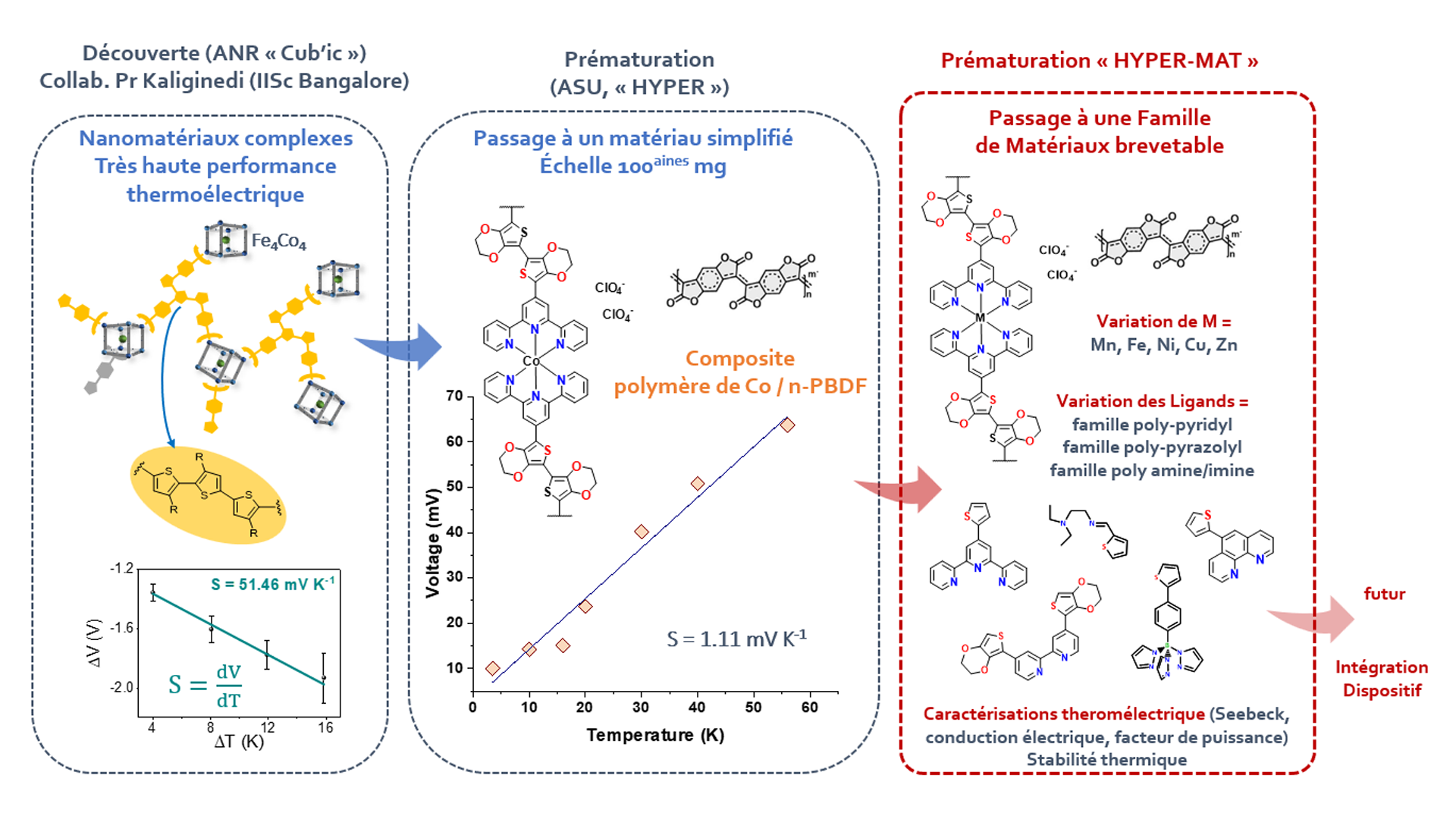
As part of an ANR-funded project, we developed a new class of molecular hybrid materials with outstanding thermoelectric performance. An initial pre-maturation project (HYPER, funded by the PUI Alliance Sorbonne Université) made it possible to significantly simplify their architecture, reduce the number of synthesis steps, and produce the material in quantities sufficient for prototype development, while maintaining performance levels that exceed the state of the art for organic materials designed for flexible electronics.
The HYPER-MAT project represents the next stage of technology maturation. It aims to develop a series of hybrid thermoelectric materials derived from this first simplified material and exhibiting similar properties. The objective is to strengthen the intellectual property portfolio surrounding this new family of materials while anticipating the subsequent steps required to integrate them into flexible thermoelectric generators.
Target applications include the autonomous powering of sensors, wearable electronic devices, and, more broadly, low-temperature energy harvesting technologies.
