About polymer recycling and the importance of discussing it: a spotlight on Agathe Navailles
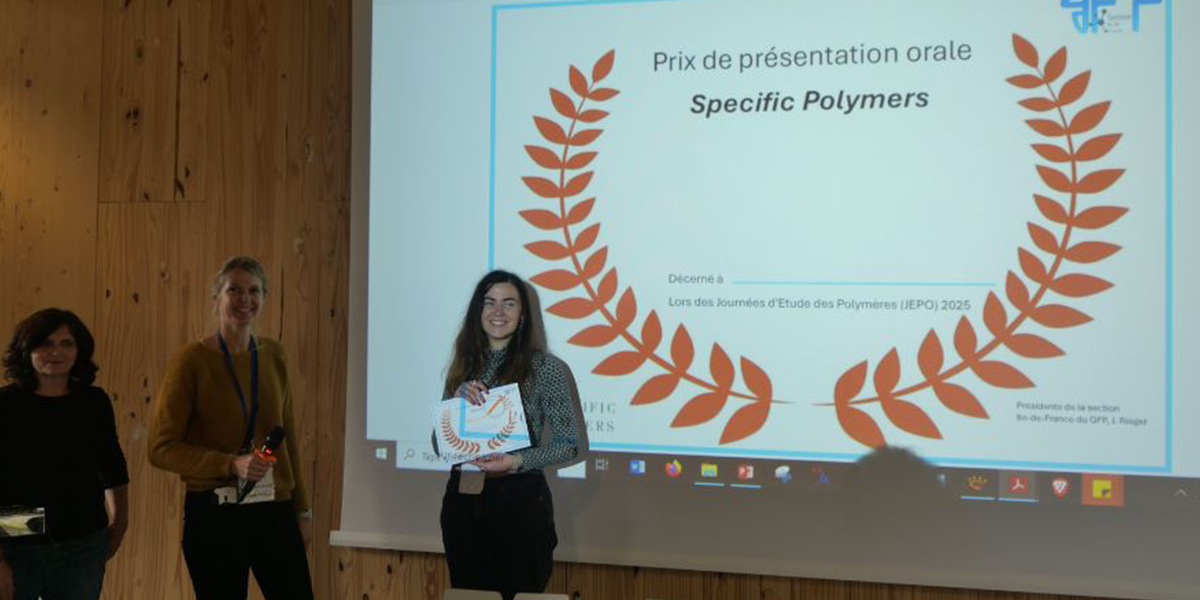
Last October, at the Journées d’Études des Polymères (JEPO), Agathe Navailles was awarded the prize for the best oral presentation for her work on the recycling of ABS/HIPS polymer blends derived from waste electrical and electronic equipment (WEEE).
This award recognises the scientific quality of a PhD thesis carried out at the PIMM laboratory (ENSAM Paris), co-funded by the DIM MaTerRe and the Urban Mines Chair as part of the WAIP project, and supervised by Matthieu Gervais (PIMM), Sébastien Roland (PIMM) and Fabrice Detrez (MSME).
The WAIP Project
Plastic recycling presents a considerable challenge, particularly with regard to the polymers found in this waste. Effective recycling requires additional sorting stages, which have not yet been implemented on an industrial scale.
The stream of material to be recycled is a mixture of polymers with mechanical properties that are inferior to those of virgin polymers, particularly in terms of impact resistance.
WEEE is therefore mainly composed of acrylonitrile butadiene styrene (ABS) and high-impact polystyrene (HIPS), two amorphous polymers with immiscible styrene matrices: SAN for ABS and PS for HIPS, both reinforced with polybutadiene nodules. The ABS/HIPS blend therefore has a complex microstructure, characterised by two types of nodules distributed within a multiphase matrix. Furthermore, this microstructure is strongly influenced by the processing conditions of the blend.
Given this complexity, the WAIP project proposes an iterative approach involving processing, microstructural characterisation and the measurement of mechanical properties. Establishing correlations between the morphology of the blend and its macroscopic performance would enable the identification of optimal processing conditions to increase the impact resistance of ABS/HIPS blends.
Agathe has therefore studied twin-screw extrusion and injection moulding processes and identified the processing conditions that increase the impact resistance of the resulting blends. These initial results now open up new avenues of research. These include combining these two processes, as well as deepening our understanding of the deformation behaviour of microstructures. To this end, Agathe is developing a finite element simulation to identify the roles of various mechanical phenomena in material damage.
Plastic recycling: new challenges
Beyond the scientific and technical advances brought about by this work, this research is also part of a broader discussion on contemporary issues relating to plastics. Agathe points out:
“I felt it was important to explore the issue of plastic recycling from an interdisciplinary perspective. The Tribunal for Future Generations, organised by the DIM MaTerRE, the Doctoriales Recherches-Ressources 2025, the series of conferences on plastics organised by the FMSH (Fondation Maison des Sciences de l’Homme) and the Tara Ocean Foundation, as well as the various studies supported by DIM MaTerRE and the Urban Mines Chair (particularly on the issue of resource efficiency) all provide opportunities to realise that plastic recycling is, above all, a societal issue.
Developing and improving recycling technologies is certainly necessary, but does not appear to be sufficient to counterbalance the growing market for polymers. This has convinced me of the need to share our science and to fully integrate science communication into my PhD work: talking about science to as many people as possible also means raising awareness of plastic not as a low-value disposable item, but as an essential high-performance material with environmental, social and economic impacts, from its production to its end of life.”
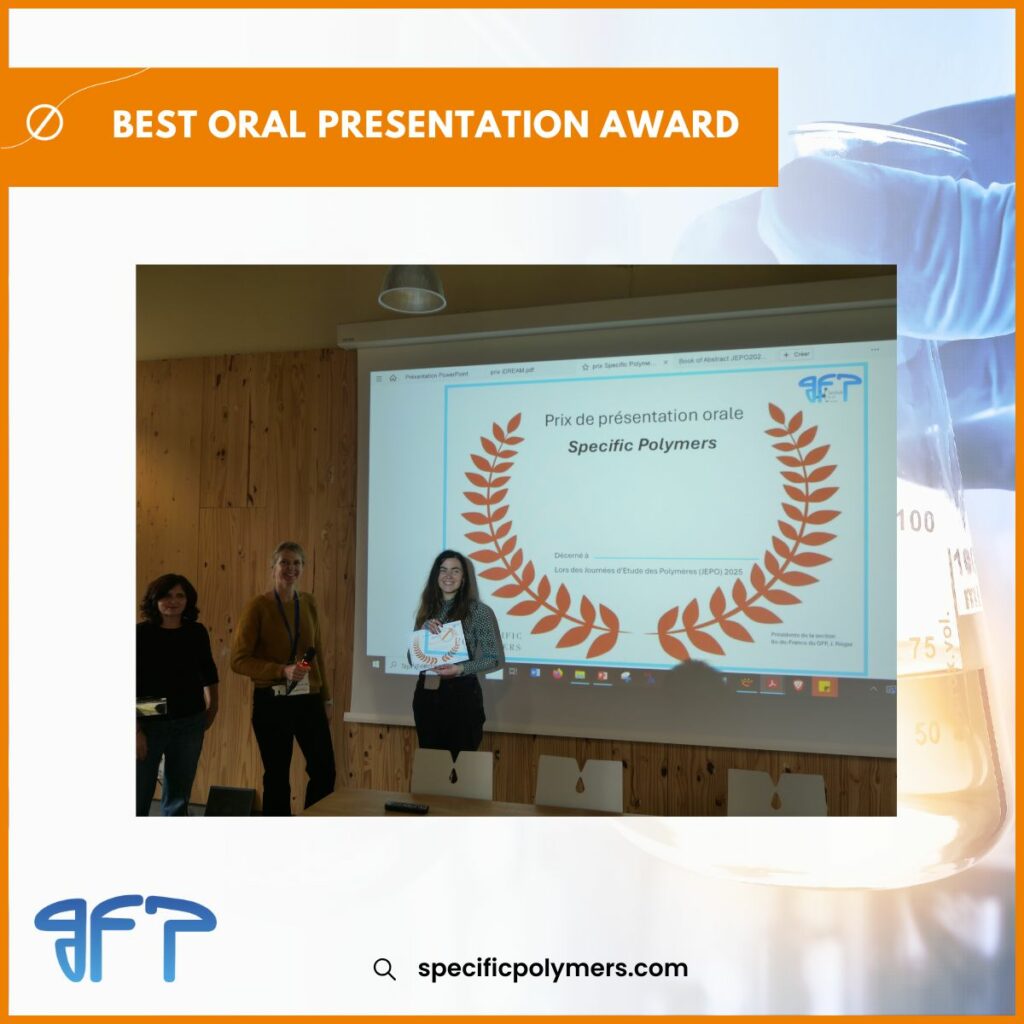
Agathe Navailles with Jutta Rieger and Nadège Pantoustier
crédits @specificpolymers