

PRIME-PB-BAT
Understanding PRoton Insertion MEchanisms in Prussian Blue Analogs via Electrogravimetric and Optical Monitoring: From Fundamentals to an All-Prussian Blue Proton BATtery Demonstration
PRIME-PB-BAT aims to develop a safe, low-cost, and sustainable aqueous proton-ion insertion battery by exploiting the exceptional mobility of protons and the intrinsic safety of aqueous electrolytes. A central bottleneck for proton batteries is the identification of well-matched anode/cathode couples that operate reversibly via proton-driven charge storage while avoiding the limitations of aqueous systems, including the narrow stability window, hydrogen evolution, dissolution, and long-term interfacial instability.
The project focuses on Prussian Blue Analogues (PBAs) as earth-abundant, composition-tunable proton-storage hosts. Although PBAs show promising behavior, current studies often rely on strongly acidic conditions and indirect evidence, leaving the charge-compensation mechanism (H⁺ vs host alkali ions, and possible proton–water co-transport) insufficiently resolved and hindering translation to robust full cells—particularly all-PBA proton full cells, which remain rare.
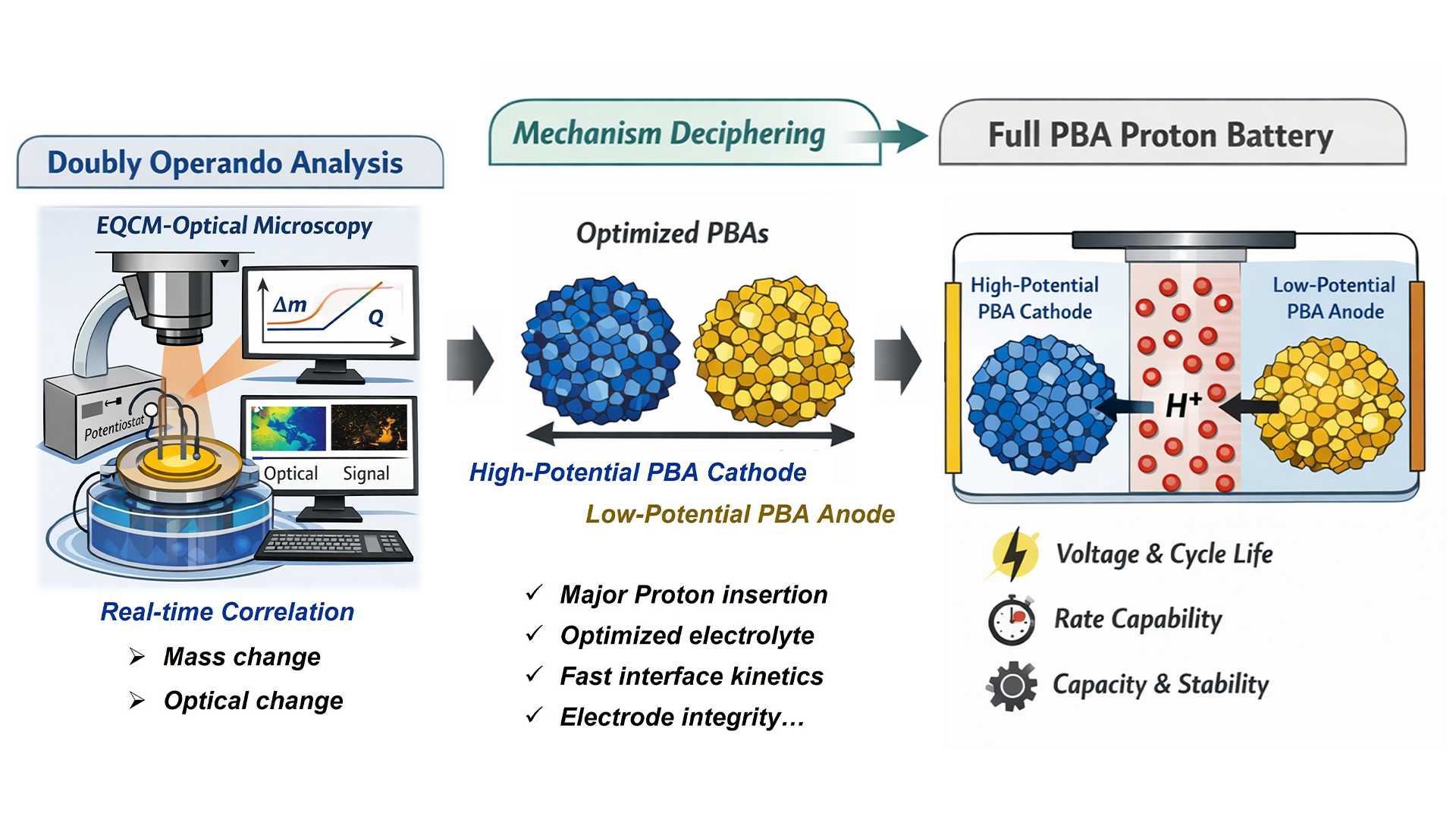
To overcome these barriers, PRIME-PB-BAT will combine mildly acidic buffered electrolytes with a doubly-operando “color electrogravimetry” platform that directly couples EQCM and high-resolution optical microscopy. This approach will quantify redox-induced mass variations and correlate them with optical changes during cycling to (i) identify the active ionic species and their interfacial transfer kinetics, (ii) separate multi-ion contributions and the role of coordinated/uncoordinated water, and (iii) guide electrolyte formulation (additives, buffering). Correlating optical changes with spatial homogeneity during cycling will be highly valuable, as achieving a homogeneous spatial distribution may promote efficient interfacial ionic transfer, govern the rate capability of the electrode, and help identify failure mechanisms during operation. Mechanistic insights will then be used to rationally tune PBA composition (high-spin/low-spin chemistry, substitutions, vacancies, hydration) and assign high-potential and low-potential PBAs as cathode and anode, respectively.
Building on demonstrated feasibility of the coupled EQCM–optical method, the project will deliver a mechanism-guided route from materials understanding to device design. The expected outcome is the first demonstration of an all-Prussian Blue proton battery operating in mild aqueous media, achieving targeted performance metrics and supported by a robust,